Ever wondered what it’s like to be a Time Rep? Well here’s a few pages from the employee handbook:
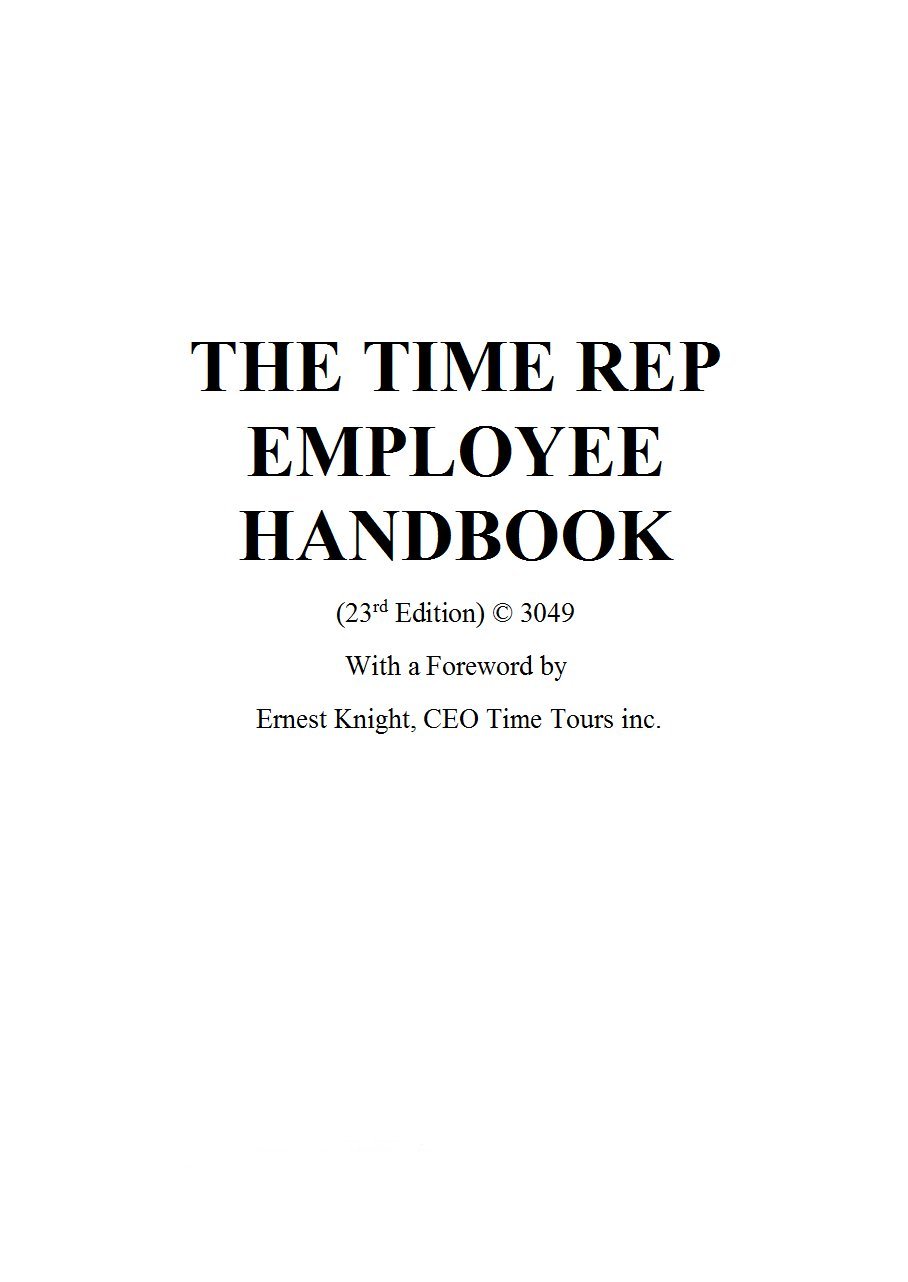


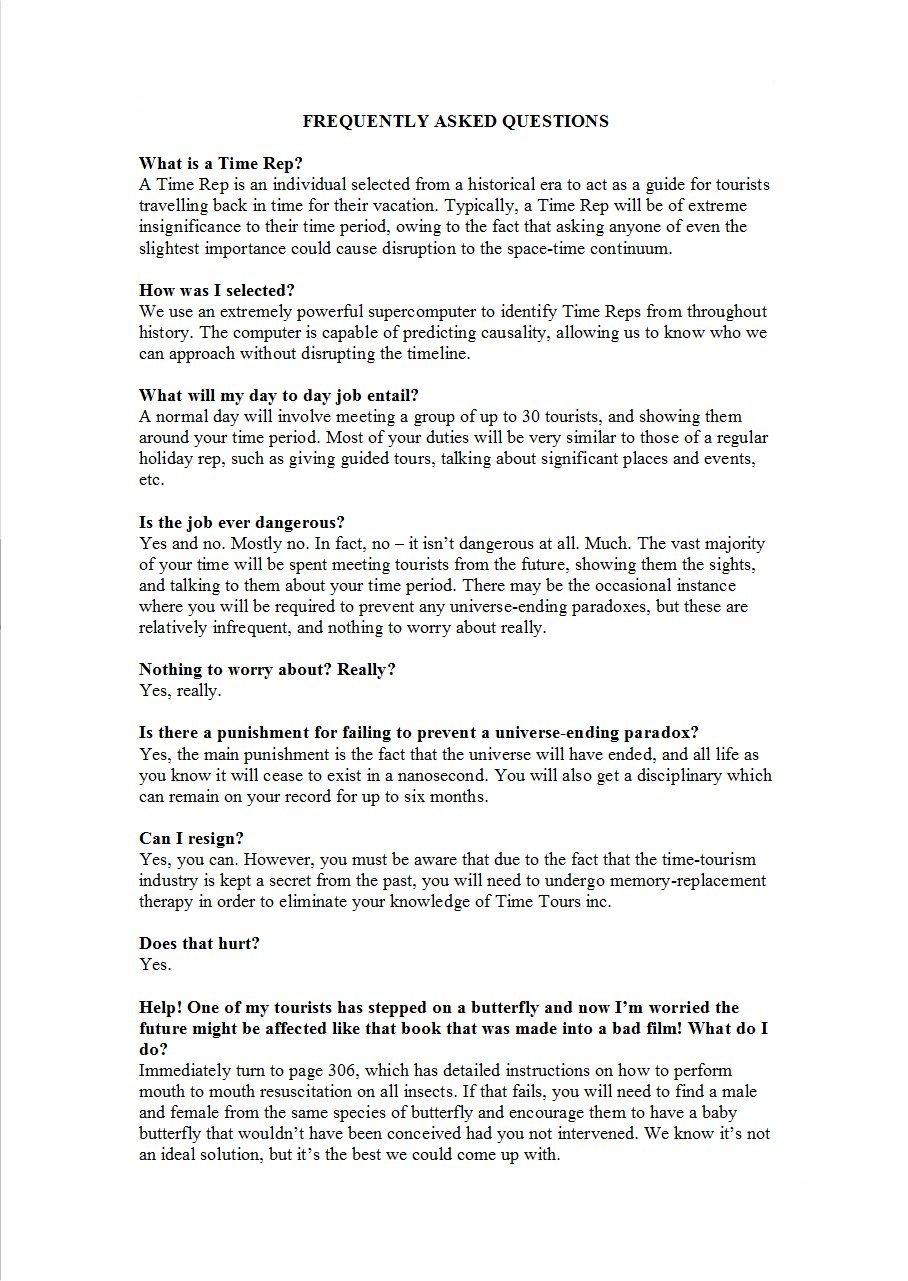
Ever wondered what it’s like to be a Time Rep? Well here’s a few pages from the employee handbook:
“I think I might do some tips on writing dialogue for my next blog entry,” I said, taking a seat next to my friend.
“Oh yeah, because you’re such an expert on writing dialogue,” my friend replied.
“Okay, okay – maybe I’m not exactly an expert, but I think some people might find it useful.”
“Oh yeah? And which people would that be? Ones who like taking advice from people who admit they aren’t an expert on a particular subject?”
“Yes,” I said. “Those people.”
“But there are hundreds of websites that already offer tips on how to write good dialogue! Why would anyone want to listen to you?”
“I don’t know,” I said, rubbing the back of my head. “Maybe if I thought of an original way to present the tips – something funny – people might read it…”
“Something funny?”
“Yeah.”
“Like what?”
I paused for a moment.
“Here’s an idea,” I said. “How about presenting the whole piece as if it were a section of dialogue itself?”
“That’s the dumbest thing I’ve ever heard,” my friend replied, “and I think you’re just trying to be funny for the sake of it. Can’t you just do bullet points like all the other websites? Everyone like bullet points…”
“That is true,” I agreed, “but this might work better.”
“I doubt it,” my friend said. “How would you start it?”
“I think I might do some tips on writing dialogue for my next blog entry.”
My friend blinked.
“I know – you’ve already told me that.”
“No, that’s how I would start it.”
My friend sighed.
“Oh dear,” He said, shutting his eyes. “This is going to be a long day. Okay – what would you do next?”
I smiled to myself.
“Well, I’d then run through our entire conversation up to this point.”
“The entire conversation?”
I nodded.
“But why would anyone want to read that? And besides – aren’t you supposed to cut out unnecessary dialogue from what people say in real life?”
“I don’t know – are you?”
“Yes. Because in real life, conversations are long and boring. Like this one, for instance.”
“I disagree,” I said. “I think in certain circumstances it can work quite well to keep everything in. Makes it more real.”
“So what are your tips for writing dialogue then?” My friend asked.
“Well, I think the first one would be to read all your dialogue out loud,” I said. “For me, it’s the best way to understand the rhythm of what someone is saying. And if you find yourself tripping over any words, they’re probably not the right ones, so change them.”
“Are you going to read this out loud after you’ve finished writing it?”
“I guess.”
“You poor man. Okay, what’s the next tip?”
“I think it would be to remember the context in which your characters are talking,” I said.
“What do you mean by that?”
“Take the conversation we’re having right now. How we’re talking is fine, but that’s because we’re just sitting down, having a chat.”
“But we’re sitting down on a roller coaster!” my friend said. “And we just went round a loop-de-loop two seconds ago! Most people wouldn’t be having a conversation about writing dialogue at a time like this!”
“Yes, but we’re not normal people, are we? If we were running away from a murderer or in a hurry to get somewhere, we might not go into as much detail as we are now. In fact we’d probably not talk at all.”
“I wish we weren’t talking at all now,” my friend said, looking over his shoulder. “Where’s a rampaging murderer when you need one?”
“I think that leads nicely into my next tip,” I said, “which is to make sure your characters don’t over-explain everything.”
“Yeah, I hate it when writers do that,” my friend replied. “I think it happens when they get too close to the detail and feel they need their characters to deliver reams of exposition, just to make sure the reader gets the point. In real life though, people just don’t talk like that.”
“I think another common mistake is when people deviate from using ‘he said’ / ‘she said’ at the end of a sentence,” I announced, “and before you know it they’re using stupid words like ‘reasoned’, or ‘chuckled’, or ‘announced’.”
“Absolutely,” my friend exclaimed.
“Truth is, ‘he said’ / ‘she said’ works just fine, and most readers gloss over them as terms anyway. In fact, at times it’s best to have nothing at all – especially if you only have two people talking, and it’s clear who is saying what.”
“I disagree,” another voice interrupted. It was my second friend, who had been sitting behind us on the roller coaster the whole time. For some reason, neither me or my friend had chosen to acknowledge him in the conversation up to this point, so if you were only listening to what the two of us were saying, you wouldn’t have known he was there. What a strange conincidence!
He leaned forward to speak.
“There are some words you can use instead of ‘he said’ or ‘she said’ just fine.”
“Yeah – like ‘replied’.” My other friend replied.
“This is very confusing,” I said. “Can we keep this conversation to between two people please? Otherwise it’s going to be difficult for the reader to understand who is saying what when I write this all down.”
“Fine,” my second friend said, leaning back and crossing his arms. “I won’t say another word.”
“Where were we?” I said to my other friend who wasn’t the second friend who’d interrupted us for no reason.
“I think we were on the verge of killing ourselves,” my friend replied. “Or at least I was. Are we nearly done?”
“I think so,” I said. “I’ve only got one final point to make.”
“Thank God. So what’s that?”
“Use clipped sentences a lot.”
“Clipped sentences? What are they?”
“They’re the sentences that Microsoft Word doesn’t like.”
“Microsoft Word?”
“Yeah, you know – it underlines them in a green squiggly line because it thinks you’ve made a grammatical error.
“It does?”
“Yeah. So use lots of them.”
“So let me get this straight: what you’re saying is, if you’re using Microsoft Word to write your book, and there are lots of green squiggly lines all over it, it’s probably a sign that you’ve written some good dialogue?”
“Exactly,” I said. “Green squiggly lines are your friends.”
So for the next entry in my series on writing, I thought I would talk about how to come up with a decent plot. After all, it’s one of the most important things to consider when writing, because every book is built around a good plot, right?
Wrong. The first thing to remember is that you don’t necessarily need a great plot – some of the best books I’ve read have been complete nonsense from a plot perspective, but stand up as some of the greatest works of literature nonetheless. All that matters is that you care what is happening to the people in the story, and for that you need good characters.
But I’ll come onto characters another time. For now, let’s just say that you’ve decided your book needs a decent plot to carry the story through to the end. I find this element of the writing process really hard, not least because most of the great plots have already been written – it is difficult to come up with something original these days, and if you need further proof of that, just look at how many Hollywood remakes there have been over the past few years, or even re-remakes. Even the most experienced storytellers are finding it hard, so if you are struggling, don’t despair – you are not alone!
So when I’m trying to come up with a plot, I try and keep the following five rules in mind. Now, there may be some of you who find the idea of applying rules to the process of creative writing to betray the principle of writing creatively, however in this case you should just obey these rules. Trust me – it will make your life waaaaaay easier:
1) Treat your plot as its own character.
You know that point in writing where your characters are so well defined, they begin to do their own thing without you even realising it? Even though you are their creator, you no longer decide what they do – he or she now behaves in their own way in your mind, and you are merely writing it down. You know you have got to this stage with a good character, because if you do try and force them to do something that goes against their nature, you cannot reconcile it in your mind. It’s the same with a good plot – once a story arc has been nurtured to a certain point, it develops its own natural momentum, and you no longer need to think too hard about what happens next – the plot takes care of itself. Know when to spot that your plot is at this stage, and just let it happen.
2) Don’t worry about where the story is going.
I know some writers try to plot out the entire story before they get started. They want to know about all the underlying themes, all the key plot points, all the twists, the ending, everything. They may want to use some dramatic irony to hint at things to come in the first stages of the novel, and for that, they need to know what’s actually going to happen. If you are someone who likes to write this way, then great. However, you mustn’t be afraid to just put pen to paper and get started if you’ve only got that initial idea, or a specific scene in mind, or even just a conversation between two characters, fleshing out everything from that starting point as you go.
I find it sometimes works better if you have no idea what is going to happen. After all, your central characters are not usually privy to future events, so if you as the author are in the same position, it can produce some interesting results. What’s more, there’s nothing like the thrill of your own story taking you by surprise! Some of the greatest turning points in classic stories have happened this way (Dan O’Bannon for instance had no idea he was going to come up with the chest-burster scene in Alien when he started writing it), but you have to be prepared to set off on your writing journey without knowing where it will go.
3) Don’t be afraid of using clichés
Many authors like to think of themselves as being highly original. How many times have you sat in front of your manuscript, happily typing / writing away and thinking to yourself “No-one has ever thought of this before! I’m so clever!” Ok, maybe that’s just me. The downside of thinking this way is that you can be afraid of resorting to clichés. Now, you need to be careful not to fall back on them too much, but there is a reason clichés are clichés, and that’s because they work really well. Sometimes, the best and most satisfying way to resolve a plot point is to resort to a cliché, so don’t be afraid to do it.
4) Obey the three act structure.
So you think you can be really innovative and write a story that spans four acts, or two acts, or one act? Or half an act? Don’t bother. The three act structure is the only way to go. Setup, confrontation, resolution. Plot points can drift between the different acts depending on the balance of your story, but as human beings, we like things in threes. The three act narrative is by far the most proven, and the most satisfying. So obey it as a structure for your book.
5) Remember the eight-point arc.
Nigel Watts was a clever man, and he came up with the eight-point story arc in his book “Writing a novel and getting published”. The basic idea is that within your three acts, you should have eight points to your story arc. Now, there are loads more websites that talk about this with far greater authority than I ever could, so look them up. However, to give you a brief guide, they are as follows:
Stasis: This is where you establish the normal way of life for your characters and the particulars of your world. A good example of this would be when we meet Luke Skywalker at the beginning of Star Wars working on the farm, or Neo in The Matrix going to his dull job.
Trigger: Oh no! Something beyond the control of the main character has happened, and this has set our story in motion! Bear in mind that the trigger can be good (boy bumps into beautiful girl in the street) or bad (boy bumps into an alien invader in the street). Either way, this is the thing that sets our main character off on…
The quest: So the trigger leads to the quest, and the quest usually takes two main forms – make everything go back to normal (i.e. the hero defeats the invading aliens), or make things better (i.e. the girl falls in love with the hero and they go off and have lots of baby heroes.)
Surprise! This part of the story arc involves lots of stuff happening, and should take up most of the story. Here’s where you chuck in all your mysteries, discoveries, complications, etc. Basically stuff for the protagonist to overcome. And no deux ex machinas please – you should tread carefully between having something that catches the reader off-guard, but not something so ridiculous that it pushes the reader’s willingness to accept what is happening to breaking point.
Critical choice: In my opinion, this is by far and away the most important stage in any story. But what is it? Well, at a certain point in your story, your protagonist needs to make a pivotal decision. This is where we finally get to see how the character has developed since we were introduced to them at the beginning of the book, as a person’s true nature is often revealed when they are under the most pressure to make a decision. Nigel Watts is very clear on this point, and says that the critical choice must be a decision made by the character, taking them down a certain path – it cannot just be something that happens to them randomly. Think of a classic story, and it won’t take you long to see where the main character had to make a critical choice. It usually involves choosing between a good but difficult path, and a bad but easy one. Luke Skywalker not joining Darth Vader is a good one.
Climax: So your protagonist has made their choice, and goodness me was it a critical one! Ok – now it needs to lead to the climax. This is where your story peaks in terms of excitement! Death Star, anyone?
Reversal: This is what transpires as a result of the critical choice and the climax, and it should change the way your characters behave – in particular your protagonist. Luke Skywalker finally uses the force! Neo can see the Matrix! Like with the “Surprise” element of your plot though, there should be no deus ex machinas here. As I said earlier, the story should evolve naturally, as though it were a character itself.
Resolution: Phew! The story is done, but now things are different. The resolution should show what the new “stasis” is – this can be good or bad depending on the critical choice, but for better or worse, your characters should have changed, and your story should be all tied up. This doesn’t mean you can’t have an open ending, but all your plot strands should be left in an appropriate state to end a book, leaving the reader either satisfied with the conclusion, or eager to find out more…
Anyway, there you go. Now we’re at the end of this entry, I suppose it’s customary to say something along the lines of “of course, these rules are just a guide, so feel free to write however you like”, but if you ask me, I wouldn’t stray from them at all.
Another excerpt from The Bluffer’s Guide to the 21st Century © 3049 Time Tours inc. has appeared:

Ok, get ready for an onslaught of self-publicity – Time Rep is now available to pre-order in the iBookstore, using the incredibly easy-to-remember link below!
https://itunes.apple.com/us/book/time-rep/id652863776?mt=11
To find the actual “pre-order” button, you will need the following:
What to do:
1) Take the binoculars and attach a magnifying glass to the end of each lens using your sticky tape.
2) Once they are firmly attached, hold the apparatus over your eyes.
3) Take the masking tape, and starting from the back of your head, wrap the tape around and around until the binoculars are stuck to your face. If you are under the age of 18, you may need help from a parent or guardian.
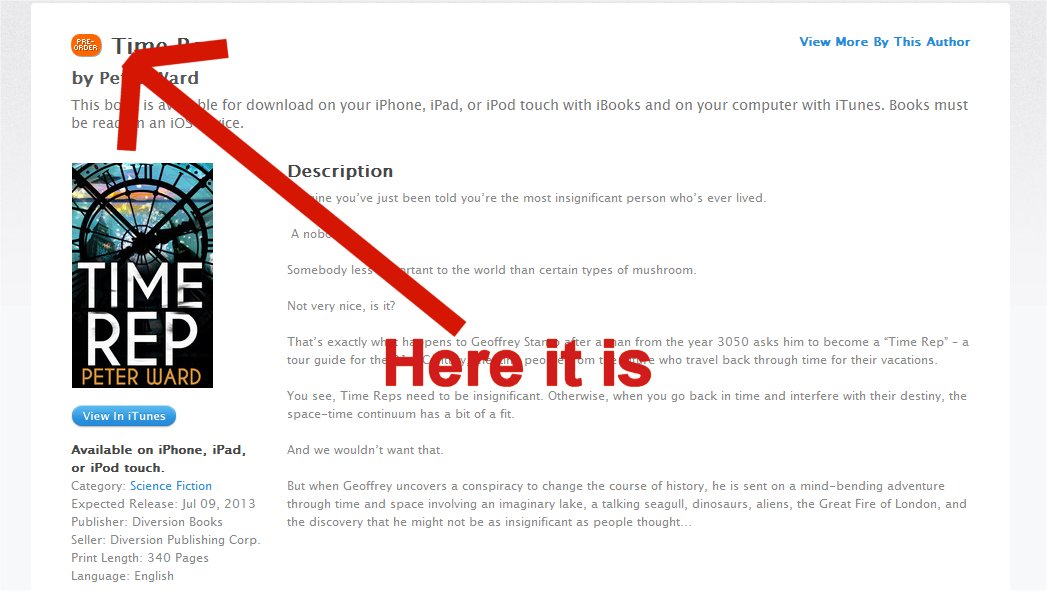
4) Look at the pre-order page. You will now be able to see a very small, orange pre-order button in the top left corner of the screen.
5) Click on the button. Congratulations! You have pre-ordered Time Rep!
If you still can’t see it, I’ve attached an image below that hopefully makes it clearer:
It’s also available to bloggers and early reviewers on Netgalley:
https://www.netgalley.com/catalog/show/id/31767
I much prefer this page as it has a massive green “request” button slap bang in the middle of it. I understand many reviewers have already made requests for the book, so thank you. I hope you enjoy it. I am perfectly willing to send bribes in return for favourable reviews, so if you are like me and have no moral standards, contact me directly and I’m sure we can come to some sort of arrangement.
Finally, the book is now on Goodreads as well, so if you feel an overwhelming urge to add it to your “to-read” shelf, don’t hold back! Add away! The link is here:
http://www.goodreads.com/book/show/17974332-time-rep
Ok, that’s enough about how everyone should pre-order Time Rep and give it great reviews. In order to give this post some balance, I feel I should also say something negative about it, so here goes: Looking back on the book, I think at least three of the jokes could have been funnier.
There! Balance has been restored!
Picture the scene: You’ve just sat down at your computer / writing desk / typewriter, ready to start writing your book. So much preparation has led up to this moment – you’ve spent weeks working out the intricate plot details. Developed your character arcs. Thought about your underlying themes and the key messages you want to get across to the reader. So many details are buzzing around in your head that you feel your mind is about to burst if you don’t start writing something, and that moment has finally arrived.
You are ready to start on your book.
Only problem is, you can’t think of a name for your main character.
For some people this isn’t really a problem – they can just start writing with a substitute name like “Mr Poopy Bum Bum Head” until they think of a better one. And that’s fine, but if you’re anything like me, a character’s name needs to be finalised before you can start writing about them, unless of course you’re writing some highly pretentious avant-garde story where none of the main characters actually need names because it turns out at the end in a dramatic and poignant twist that they’re all actually leaves on a tree or something.
My problem is that I’ve got to know a character’s name before I know how they will behave, what their demeanour will be, and how they will react in certain situations. This is especially true if the characters happen to coincidentally share a name with someone I know or have met in real life. For instance, a characer called “Mark” will behave very differently from a character called “Dave”. That’s why I need them to have a name, and why the name needs to be right. It has to feel right. It has to sound right. It has to have the right rhythm when someone says it. Maybe I place too much importance in a name, but for me, the wrong name can really send a character off balance.
Naming the characters in a book is really hard. You think parents have it tough naming their child? Well how about doing that multiple times for every character in your book? Sure, the characters are fictional, whereas the child is a real person who will have to live with that name for the rest of their life, but it’s still bloody hard. So how do people go about it? Well, for me there are only five ways:
1) Trial and Error
This is where you kind of have an idea of a first name, but then come up with a million surnames that you think fit the first name. The problem with surnames though, is that they can be anything from “Smith” to complete nonsense (like Bruntlefordworth), and if you think about any name hard enough, it begins to lose all meaning in your mind until it resembles more of a shape than a sound. At this point you go slightly mad and revert back to something familiar. This is a good method that works really well for coming up with obtuse names, but do be prepared to lose it a bit before you get there.
2) The Charles Dickens School of the bleeding obvious
Charles Dickens didn’t like to leave much to the imagination when he named his characters. For instance, Mr Gradgrind (the Headmaster in Hard Times) wasn’t exactly somebody who encouraged his pupils to sit on bean bags all day plaiting each other’s hair. Gradgrind was someone emotionles; a man obsessed with cold, hard facts, you knew this immediately from his name. In a sense, his characterisation was complete once Dickens chose his name. So there you go – if you have a abusive husband in your story, you may want to go down the route of naming him Mr Hitgirl Badman Naughtyhead or something.
3) Name them after someone famous
Does your central character share a trait with a real life figure? Or perhaps a famous figure in fiction? Then why not name them after that person? George Orwell did a mixture of this in 1984 by calling his protaganist Winston Smith – the “Winston” evoking the strength of Winston Churchill, with the “Smith” implying an everyman facet to his character. Clever huh? At worst, no-one will spot that you’ve done it, and at best people will think you are far better educated that you actually are for making such an intelligent connection between your character and a comparable person in real life. Just don’t make it too obvious by calling your hero “Geoffrey Obama” or soemthing.
4) Make it up
This is my favourite method of naming characters. Just make it up. Try not to put too much thought into it and eventually you’ll hit something that sounds just right. Don’t force anything – just relax and let the name come to you. A forced name really shows if it has been dwelled on for too long. Let go of your concerns about how the name will be perceived by the reader and you’ll just open yourself up to knowing when you’ve hit on the right names. And make sure you read them all out loud to work out how they will sound to the reader. Look all around you for random inspiration. Take a look at books of your shelf and merge the first name of one author with the surname of another. You’ll come up with some bonkers names that will make you laugh, but eventually you will get there. My friend Dunstable Huntyford swears by this method.
5) Call them Dave or James
Everyone knows a Dave or a James, so just do that.
So that’s it – obviously there are many ways to go about deciding on a name for your character, but the methods above have always served me well…
Here’s an interesting except recovered from The Bluffer’s Guide to the 21st Century (©3049 Time Tours inc):

One of the most common pitfalls when it comes to writing a book, or any form of writing for that matter, (with the exception of writing a shopping list, which is quite straightforward if you know what you want) is dealing with writer’s block. Writer’s block has the power to stop any author in their tracks, no matter how experienced, talented or creative they are. I’ve certainly suffered from it in the past, to the extent where the writing of my first book Time Rep was put on hold for three years until I found a way to progress the story, so I thought it might be useful for other writers out there if I offered some hints and tips as to how to deal with it. Now, I’m not promising any silver bullets here (which wouldn’t work anyway since writer’s block is a mental condition, and as such not that bothered about being shot at), but these techniques have worked for me in the past, so they may work for you too.
But first, what is writer’s block? Wikipedia defines it as “a condition, primarily associated with writing as a profession, in which an author loses the ability to produce new work. The condition varies widely in intensity.” I define it as a condition that emerges when you sit down in front of your computer to do some writing, only to find that after seven hours all you’ve got to show for it is this:

Look familiar? I think we’ve all experienced something like this, haven’t we? But fear not! Dr. Ward* is here to offer you five simple ways to overcome writer’s block and continue with your work. Let’s begin, shall we?
1) Remember you are not alone.
You’ve got friends, right? Use them. If you’re halfway through your story and you’re stuck, get them to read it and give you their thoughts. Sometimes, a fresh pair of eyes will pick up on something you’ve missed, or come up with an idea you would never have considered. Also, don’t be too proud about having to come up with the whole story yourself. Whilst writing Note to Self, I was stuck halfway through the story for many months before my girlfriend suggested a different direction for it to go in. I listened to what she had to say, and within a few days I was writing at full steam again. Do bear in mind though that some friends have no idea what they are talking about, so just ignore them.
2) Don’t be too hard on yourself
We all want our writing to be as perfect as possible, demonstrating how amazing we are with our use of language. Sometimes though, authors become so obsessed with getting it right first time, they put roadblocks up for themorgg – (sorry, the cat just jumped on my lap…) Where was I? Ah yes – sometimes, authors put roadblocks up for themselves, unwilling to progress untiff (now the cat is licking my hand as I type, which is very distracting…) What I’m trying to say is that it doesn’t have to be right first time. If a particular section is holding things up, write it as best you can and move on. You can always correct it later, just as I haven’t done with this point.
3) Beware of over-writing
This links back to the last point really. Some authors will finish a chapter, then write it again, and again, and again, and again. And no matter how many times they go over it, they’ll never be satisfied. I find it’s best to just write something once. Then it is fresh, and you can move onto the next bit. The more you focus on one particular section of your writing, the more you become bored with it, and less stimulated by your work overall, which allows for writer’s block to set in.
4) Have a break!
I was having trouble thinking of how to start this point, so I stopped writing, went for a walk, had a cup of tea, and came back a couple of hours later. Unfortunately I still have no idea how to start writing about why taking a break now again can re-invigorate your writing, so that didn’t work. Normally it does though, so do that.
5) Be prepared to ditch what you’ve written.
This is probably the most important point, which I will illustrate using a bad metaphor that I’m thinking of deleting because it’s not that good: Imagine you are driving to a party. You’ve memorised the route and are confident about the directions. But at some point, you accidentally take a wrong turn, and after a few miles you are lost. What would you do? Most people would turn the car around and drive back to a point in the route they recognised, then head off in the correct direction. But there will always be those who don’t want to admit the route they have taken is wrong, and will keep driving forwards, hoping that the party will miraculously appear around the next corner. It’s the same with writing. At some point, you may have to be brave and admit that the direction you’ve taken your story in isn’t working. Retreat back to where you knew what you were doing and head off the right direction.
That’s all for now – if you are someone who frequently suffers from writer’s block, then I hope these pointers have helped in a small way. Until next time!
* I do actually have a doctorate, in making up qualifications for myself
It will come as no surprise to the three people out there reading this that I haven’t quite decided on what form this blog should take yet. So far, the only thing my posts have had in common is that they both talk about the fact that they are part of a blog. In other words, they both break through the fourth wall in a mildly amusing, self-referential way. But I can’t keep that up forever – if I only ever write a blog about having a blog, eventually the text will condense in on itself in a big ball of words, turn into a black hole, and swallow the universe. And then I’m really going to struggle to get more readers, unless there are some people living beyond the known plane of existence, on the lookout for a blog written by an author who hasn’t had his books published yet.
Which, let’s be honest, is unlikely.
So I’ve decided that it’s time to write about something other than the blog itself. Now, the astute of you out there will realise I’ve already blown it with this very post, however you’ll be pleased to know that I have been thinking up some new rules and groundbreaking ideas for my next entry. Some of these ideas are quite radical and may scare a few of you, but here they are nonetheless:
1) Stop making excuses to have some sort of list in every blog entry. They were funny at first, but now you’re only using them to make what you’ve written look longer because you can have lots of line breaks.
2) Having said that, the lists can be funny if you immediately contradict the previous point, so if you are going to have a list, make sure you do that.
3) Think more about what you are writing. Don’t just sit bleary-eyed at the computer at 8.19 on Sunday morning, typing out a stream of consciousness and uploading it to the site…
4) … Or if you do, don’t tell anyone that’s what you’ve done.
5) You are now in the stage where you are waiting for the books to come out, so why not use this opportunity to talk to people about how that feels? What is it like waiting to see what the cover designs will look like? What other things do you have to do as an author in the run-up to a book launch?
6) Write about some famous people in the blog so that more people might accidentally stumble upon your site looking for someone they’ve actually heard of. A good list of names you might want to think about randomly dropping into an upcoming post to get a decent cross-section of visitors are: Vic Reeves, Samuel L. Jackson, Charlie Brooker, Stephen King, George Lucas, Beckie McDonald from Coronation Street, Barack Obama, Tony Stark, Angelina Jolie, ‘H’ from Steps and the Pope. Also, if you’re struggling to think of a title for a blog post, why not just use a celebrity’s name at random?
7) Put more pictures of the cat in, because people love cats.
8) Check your spelling, because you had to correct the last post twice after uploading it. If you’d actually had some readers who immediately read everything you uploaded, it would have been embararassing.
That’s what I’ve come up with for now, so expect to see some (if not all) of these ideas having an influence on my next entry. In the meantime, here’s another picture of my cat Matilda, this time looking as though she’s just been caught trying to make herself longer than the cushion:

Until next time!
It’s an odd feeling keeping a blog at the moment, especially since there isn’t really any reason for people to visit the site yet. After all, at the time of writing, both of my books are still awaiting publication, so why would anyone bother? I actually checked the statistics of the website this morning to see how many people had visited, and was pleased to see that I’d had sixteen hits! The thing is though, out of the sixteen hits, sixteen of them were me.
So if you are reading this, I believe there are only three possible reasons:
1) You are me
2) You are a friend, and I am currently showing this to you. Don’t laugh at this bit, because it will only encourage me
3) You’re here by mistake thinking this was the website of a different Peter Ward
And there are loads of different Peter Wards on the Internet, so that last one is perfectly understandable. I had a look through Google and discovered two footballers, some businessmen, a palaeontologist, and several other authors (all ranked higher than me in the search). Then I began clicking through to the different pages. Peter Ward Homes is pretty good, offering 2, 3 and 4 bedroom homes in Driffield, Goole, Hornsea and Immingham. However, if you’re not interested in buying a home in any of those areas, it probably isn’t worth a look. Then there’s a Wikipedia page about Peter Ward the footballer, who played for Brighton & Hove Albion and Nottingham Forest in the eighties. I suppose that might be interesting if you like football, but I don’t, so we’ll stop there.
By far the best Peter Ward website I found was http://www.peter-ward.net/about/. This guy is another author like me, but judging by his website, his books look way more interesting than mine. For a start, they are all part of a trilogy called Vimp the Viking, which means they automatically have to be better than Time Rep and Note to Self before you even start reading them. Then there are the stories themselves, which draw on the Viking myths and legends. Eric and the Mystical Bear is the last book in the trilogy, and I liked the sound of the title so much, I think I’m going to read it. The stories are aimed at 9 – 12 year olds though, so it might take me a while.
But back to my original point. Why am I writing this? What is my motivation for keeping a blog when I know how few people are reading it? The answer is that there is a fourth reason someone might be looking at this: they are a future reader, and are now scrolling back through the many hilarious blog entries I have yet to write, curious to see what the first ones were like.
Well they were like this. Hopefully they got better!
 Peter Ward